|
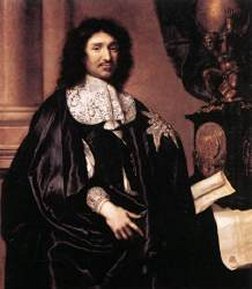
Jean Baptiste Colbert was a French statesman. Born in Reins, the son of a draper, he was trained in business and was employed first by the Secretary of State for War in 1640. He was hired by Cardinal Mazarin to look after his financial affairs in 1655. He purchased a barony in 1658 and entered the aristocracy.
On his deathbed, Mazarin recommended Colbert to King Louis XIV, who made him comptroller general of finances in 1665. Colbert helped to procure the downfall of the superintendent of finances, Nicolas Fouquet, for mismanagement. As Louis XIV's minister, Colbert scaled down the public debt by repudiating some obligations and reducing the value of others and set up a system of accounts in order to keep the government within its income. His efforts to make taxes more equal had little success in the face of localism and tradition. Colbert's aim was to make France economically self-sufficient.
One of the most successful practitioners of mercantilism, he encouraged the growth of industry through subsidies and tariff protection, rigidly regulated the qualities and prices of manufactured and agricultural products, tried to break down trade barriers within France, initiated a vigorous road-building program, and restricted the use of natural resources. In 1669 he was made secretary of state for naval affairs. He constructed shipyards, arsenals, and harbors, among them Brest and Rochefort, and began the construction of a large navy as a first step in the development of commerce and colonization.
Colbert contributed significantly to the splendor of Louis XIV's reign by patronizing the arts and sciences. He founded the Academy of Sciences and the Paris Observatory and promoted the French Academy.
His efforts at economy were soon menaced by the extravagance of the king, and the opening of Louis XIV's wars began the decline of Colbert's power and the ascendancy of the Marquis de Louvois. It was Colbert's commercial policy, however, that, by challenging Dutch commercial strength, contributed to the Dutch War of 1672-78. To meet military expenses, Colbert was obliged to resort to increased taxation, the sale of offices, borrowing, and the anticipation of future revenues. His new taxes caused serious disturbances.
Despite his unpopularity at the time of his death, Colbert was later ranked among the greatest of French statesmen.
|